Showing posts with label Bhopal. Show all posts

Thursday, December 2, 2010

Bhopal: 26 years on

Today is the 26th anniversary of the Bhopal disaster. We are still a long, long way from justice on that issue.  To remember the day, we are posting a new video blog by Annie Leonard, as well as some other interesting links.

It always feels good to do something. Click here to send an email to President Obama.

Ask him why he is willing to get tough on BP over their oil leak, but not do anything to hold Union Carbide/Dow accountable for the continuing disaster in Bhopal.

And if you want more information and analysis on Bhopal, check out some of our past posts on the subject:
And of course there is a lot of work to be done. Try these links to get involved:
  • Lots of information; a good place to give money: bhopal.org 
  • Students for Bhopal explain how to Dump Your Dow!
  • I'm a Bhopali--bloggers bring the attention back to December 3, 1984 
  • Join one of the many Bhopal-related  Facebook groups here.

Saturday, July 24, 2010

Solidarity Alert: Urgent Appeal from Bhopal Protesters

The news is not good on the Bhopal front.  Apparently, the Group of Ministers continues to disappoint.  A thousand Bhopalis are coming to Delhi on 26 July to press their case.  Of course, if they win their demands, we all win a safer, less poisonous future. 

In the name of the Commonwealth Games, the government has banned protesters from sleeping at Jantar Mantar.  (Sorry, but when it comes to a choice between Freedom of Expression and the Commonwealth Games, what did you really expect?) Because of this sad state of affairs, urgent support is needed.  There is a facebook group here.  For more about background about Bhopal and other poisonous issues, go here.

For information about what you can do right now, I'm reproducing the email from protest leaders below.  Do help if you can.
*****
Dear Friends,

It has been a disappointing few weeks for Bhopalis, with the Group of Ministers (GoM) recommendations after the July 7th 2010 verdict failing to address basic injustices faced by the people of Bhopal.  As you know, the Bhopal campaign made every effort to communicate the concerns of Bhopalis with the GoM in the years leading up to the 7th of July. Today, the gas disaster is still killing, injuring and maiming the unborn, even as the media and government debate the future of the people of Bhopal, 26 years after the gas leak.

You, as Friends of Bhopalis, have seen us through the last 26 years of struggle, through Padyatras and the setting up of the Commission, petitions, letter writing, marching, dharnas, and so much more. Today is another very important stage in this struggle for justice. We are writing for your active support at a time when 20,000 people continue to drink poisoned water, thousands of gas victims who were promised jobs remain jobless; medical treatment for the indigent victims remains elusive; the site and its surroundings are polluted, and the culprit – Dow Chemical –freely does business in India. To add to the injuries faced by victims of the Bhopal gas tragedy, we no longer have legal permission to camp on the pavement at Jantar Mantar, because of the Commonwealth Games. Without this public space, and with the disappointing list of recommendations from the GoM, we need your support more than ever! 

1000 Bhopalis will come to Delhi on the 26th of July, to demand that the State (parliament in session) take notice of them. Bhopalis will remain in Delhi until their demands are met. Your support as always would be very crucial for us. 

How Can you Help?

Support in Cash or Kind:

We need your contribution towards the expenses for food, transport and protest material. You may also support us by sharing your resources like sound systems, photocopying/printing/faxing facility.

Most importantly, since we’re not allowed to camp at Jantar Mantar anymore, we are looking for large spaces for the Bhopalis to rest in–rooms, halls etc that are close to JM, have a roof to protect from the rain, and toilet facilities close by. Do let us know if you have tents or tirpaals that you can share with Bhopalis to cover them from the (lovely and wet!) monsoons.

Please send in your donations through a Cheque payable to ‘The Other Media’ and courier it to us at: Rachna Dhingra, C/o ICJB, 44 Sant Kanwar Ram Nagar
Berasia Road, Bhopal, MP 462001

It will be great if you could also inform us through email/call if you send a cheque.

Volunteer:  As you know, being in a new city is not easy for anyone. We are looking for volunteers between the 26th of July and end of August to help take care of Bhopalis in Delhi. Volunteers will be required to stay for either a morning or evening shift. Tasks will include: taking Bhopalis to the doctor if necessary, making photo copies and phonecalls, making posters and placards and generally being on call!

---- Performers: Again, to keep the protests interesting and also keep the mood high at Dharna site, we would appreciate support from all kinds of musicians and artists who can and would like to join in solidarity at Jantar Mantar, play music, dance, sing, paint, juggle, breathe fire, etc.

----Crisis Support: Act as a Guarantor in case Bhopalis are arrested and need bail.

Solidarity Actions: Do organise solidarity actions in your city during the course of our protest in Delhi. Each action by you goes a long way in inspiring us.

So do join us in any way possible, stand in solidarity with the people of Bhopal, and contribute your time and energy towards justice! 

Please do not hesitate in clarifying any issue with us. And contact either of us to confirm your support and contribution.

Looking forward to your emails and calls!

Shalini (sh.shalini@gmail.com/99 589 24 989)

Kaveri (kaveri.rajaraman@gmail.com/ 9958789298)

(PS: Share this call for support with all your contact lists and networks)
****

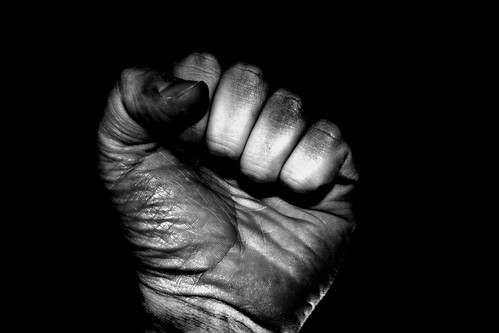
Fist Photo: bruckerrlb

Saturday, June 26, 2010

Bhopal Rally for Justice Update & Video Footage from Al Jazeera English

I was planning to write something on food today; I've been seeing a lot of interesting links about that lately.  But I put that post on the back burner, as they say, when Bhagwad asked for an update on Thursday's post

I confess that when I heard that the march that was to have kicked off Thursday's Bhopal rally had been canceled, I wondered if it had been done on account of low turnout.  That was very far from the truth.  The rally at Jantar Mantar was quite large, in part because 700-800 survivors came up from Bhopal for it.  The march was canceled not for lack of people, but for lack of permission.  (Getting permission to march in Delhi can be difficult, which is a problem in its own right.  I don't know the details of this incident, but I'm sure the request was given late, since all these events are happening so quickly, it would have been impossible to plan this months or even weeks ahead.  Marches and rallies are a vital part of freedom speech and expression, and in cases like this, the government should do what it can to fast track permission.  Otherwise, it looks like it is discouraging dissent, whether or not that is actually the case!)

On Friday, Bhopal survivors protested in front of Home Minister P. Chidambaram's residence.  As far as I know they did not call ahead for an appointment, but I think they made their point.  Photo here.

Thursday's rally got a lot of media attention, but since a picture is worth a thousand words, here's a news report from Al Jazeera English that shows actual footage.

To read more about how the Bhopal organizations feel about the Government proposal, read this editorial at Bhopal.net.

I managed to make it to two of the sessions of the Defense of Democracy event that I mentioned on Thursday, but I had other obligations and missed some of what I'd hoped to see.  Let me just say that what I did see gave me a lot to think about, but right now there are more pressing issues facing this writer: like how to respond to the demands being advanced by my children for a tasty breakfast. Though I will try to win some concessions in the negotiations--help with egg cracking or water boiling--I think I will need to move myself to the kitchen with haste or I'll be faced with  dharna in my own living room!

Thursday, June 24, 2010

Delhi Action Alert: Rally for Justice in Bhopal (Today); In Defense of Democracy (Fri.-Sat.)


As we wrote last week, it is good to see the government finally paying some attention to Bhopal.  Unfortunately, it seems that the recommendations made in the Group of Ministers' report will fall far short of reasonable.  Most disturbingly, the proposed compensation process will leave out something like 90 percent of the people affected by the disaster, including children with disabilities caused by the poison their parents were exposed to.  And while it is nice to hear that the cabinet will be discussing renewed efforts to extradite Warren Anderson, one has to take this with a fist full of salt, given the historical reluctance of the US to extradite its citizens and the signals the Indian government has sent on this issue in the past.

There has been a lot written about Bhopal recently: new blog posts, letters to the editors, and mainstream investigative stories are published every day. Many of them are well argued and insightful, like this editorial from CSE's Sunita Narain.  All this public discussion and outcry has been healthy and has moved the issue farther forward than it has moved in years.  

But as much as I like clever essays--after all, that's a large part of what we do here at the Dhaba-- my reading of the tea leaves says that the best thing we can do to move things farther along on the road to a reasonably just outcome to the Bhopal tragedy is to take some more tangible action.  If you live in Delhi and are free today (Thursday, June 24), you are in luck, because there will be a Rally for Justice in Bhopal this morning, organized by a wide range of groups concerned with justice in Bhopal.  Here's the basic information:

WHERE: Mandi House to Jantar Mantar, New Delhi
WHEN: 24 JUNE, 2010. 11 a.m. TODAY
WHY:
To condemn the latest betrayal of Bhopal

You can find more details at the Delhi Greens blog or at the Facebook event page. This rally promises to start on time, so don't be late.

BREAKING UPDATE: Just saw this update on the Facebook page: The Rally has been cancelled and the Bhopal people are now camping at Jantar Mantar.  Do join there ! 

(For those of you that spent over an hour in sweaty autos only to find no rally, let me just say that I empathize you, having done the same thing myself. I did finally manage to get a copy of Anindita Sengupta's new collection of poetry while I was in the Sahitya Akademi neighborhood, so there was a silver lining!)

You can still sign this petition from Avaaz.org.  For more about Bhopal and other related issues, see our Toxics & Trash page.
****
The BP leak, the Bhopal verdict, and the Nuclear Liability Bill have reminded environmentalists how many issues are closely related.  There are more, of course: farmers-forests-mining-Maoists are all connected to each other in important ways, as is the state's response to these things.  

A coalition of groups concerned with justice and the environment will be remembering the 35th anniversary of the Emergency this Friday and Saturday in Delhi, with a conference called In Defense of Democracy .  This agenda looks outstanding: poets, politicians, activists and all kind of other interesting people will be there.  Do attend if you can.  For more details, see the Facebook event page or look here if you don't do Facebook.
 

Saturday, June 19, 2010

Bhopal, BP, Cobalt-60: Will there be Enough Magic in this Toxic Confluence to Kill the Nuclear Bill?

The news that the Obama administration has gotten BP to pay $20 billion into an independently administered fund charged with compensating victims of the Gulf oil spill has gotten mixed reactions in the US. Many give Obama credit for wresting such a big "down payment" from BP, while others emphasize the fact that BP could--and may have to--pay much more in the long run.  And some are actually outraged because they think BP has been treated unfairly; this blogger has posted a clip of a US representative apologizing to BP for what he calls an illegal "shake down." This be-nice-to corporations approach may seem hard believe, until you read that the representative in question has received very, very large campaign contributions from BP and other oil and natural gas companies involved in the Deepwater disaster.  (He later woke up to political reality and took it all back.)

There is room to be critical of the BP-Obama agreement, but the plan does accomplish some important things: BP has had to put on hold plans to pay out dividends to shareholders this year, and many of the victims of the disaster will receive substantial relief without having to wait  years for a court settlement. Importantly, the agreement does not preclude the imposition of further fines or settlements against BP.

Now contrast this to India's approach to disaster management.  As we argued here last week, for many years that approach has been concerned, first and foremost, with sending an "appropriate signal" to foreign investors.  As we all know by now, Bhopal is the clearest example of this. After 26 years, very little has happened: the original settlement against Union Carbide was completely inadequate;people thus far tried for their role in the disaster have received ridiculously small sentences; and successive governments have failed to extradite Warren Anderson in large part because the signal they sent to the US were that extradition was not a priority

Oh, and one more small detail: the disaster at Bhopal continues, thanks to left over toxins at the old Union Carbide plant that neither Dow/Union Carbide nor the GOI have bothered to clean up. (For more on this story, read this piece in the Economic Times.)

Though it's taken a very long time, it is good to see the Bhopal issue getting some of the attention it should have gotten years ago. In fact there are new and important revelations being made every day.  And The Hindu reports that, after doing nothing for a very long time, the Bhopal Group of Ministers is actually meeting over the weekend.  The article states that "the mood at the meeting, sources said, was that something should be done, and done quickly.” It is hard to resist the temptation to make fun of this sudden change in "mood," but I'm going to sit on my hands and do so.  Instead I'll make three short, serious points:
  1. Anything good that comes out of all this will be thanks to political pressure made possible by the insulting nature of last week's Bhopal verdict and the many organizations, both here and abroad, who have been working on this issue for years. The government is only acting because it feels it has to; otherwise it would have done so years ago. 
  2. Congress/UPA governments and leaders deserve a large share of blame for this fiasco over the last quarter century; and their responsibility goes far beyond letting Warren Anderson escape in 1984. (In fairness, the BJP should be careful about what they say until they can explain why they did little or nothing to take care of this problem when they were in office.)
  3. This is not a problem without a solution! A broad coalition of groups working on this issue has put together a remarkably sensible and clear "Roadmap for Justice and Dignity."  Let's hope the Group of Ministers take heed of these demands.
It is eerie the way the uproar around the Bhopal verdict, the BP oil disaster, and the radioactive Cobalt-60 incident in Mayapuri have all happened so close together.  One speaker at last week's No More Bhopals rally in Delhi called this coincidence of toxic events, "magic."  And maybe it is magic: if nothing else, all these events are making it more difficult for the government to justify its be-nice-to-foreign-companies-even-if-they-cause-disasters attitude!

Last week, for example, the government withdrew an amendment to the Nuclear Liability Bill which would have further weakened the already ridiculously weak bill.  The revised bill wold have offered further protection to US nuclear equipment suppliers from liability in the case of a nuclear incident that “has resulted from the wilful act or gross negligence on the part of the supplier of the material, equipment, or his employee.” It's just a bit difficult to justify that kind of language, given the current climate, no matter what message you want to send to corporations!

But let's not forget the really stupid part of the Nuclear Liability Bill is its ridiculously low liability caps.The bill limits the overall amount of liability for each nuclear accident in India to about US $450 million or Rs 2100 crore.  This happens to be less than the courts awarded in the Bhopal disaster way back in 1989 But that's not all; the bill limits the liability of the private companies who would operate nuclear plants in India to mere 500 crores--(about $110 million). In the case of a big accident, the Government of India would generously make up the difference between the 500 crore that the responsible company would be liable to pay and the 2100 crore overall limit--a very nice gift to the operators of faulty nuclear power plants.

The government wants this Nuclear Liability Bill very badly; after all, it is part of the Nuclear Deal that UPA I was willing to risk a no-confidence vote over.  If I'm right, even if we kill it once it will return in a new form. And though the magic seems to be going our way this week, we're going to need more than magic to kill this bad bill!  Spread the word; let's stop it while we can!  Sign this online petition, if you haven't already. And while you are at it, sign this one from Greenpeace!

Saturday, June 12, 2010

UPA II: Who’s Fooling Who?

--ACTION ALERT--
Before you read any further, if you are outraged about the Bhopal verdict, and the government’s response to it, there will be a rally today (Saturday) in Delhi at Jantar Mantar from 4-7pm.  Details are on Facebook event page, here, or call Kabir Arora at 9911879675. A list of more things you can do follows this post.
 ***
On Thursday, I outlined, in simple terms, four things governments can do to keep corporations from behaving unsafely: regulate them strictly; punish unsafe corporations financially; punish the people who run corporations unsafely; and insure that corporations account for their long term liabilities before distributing profits to their shareholders.

Recent events, however, clearly demonstrate the unwillingness of the current government to take any of these simple steps.  In fact, in the last week, we’ve seen three examples of the UPA doing the kinds of things governments do when they want to make corporations happy, whatever the cost.  In this case, the cost may well be the health and safety of millions of people.

First, on Monday, a quarter century after what was by some measures the worst industrial disaster in the history of the world, we saw the guilty parties getting the kind of sentence a reckless driver might expect to receive after causing a traffic accident—two years in prison (with bail already granted) and a small fine.  Though the government has acknowledged that the case against Warren Anderson (the head of Union Carbide at the time of the Bhopal disaster) is not closed, they gave no reason to believe his extradition from the US would be pursued in any serious way.

As if that weren’t bad enough, the day after the verdict, the government announced it was further weakening the already ridiculously weak Nuclear Liability Bill.  The revised bill offers further protection to US nuclear equipment suppliers from liability in the case of a nuclear incident that “has resulted from the wilful act or gross negligence on the part of the supplier of the material, equipment, or his employee.”  As bad as the bill was, and it was very bad indeed, it just got worse!

Then just yesterday, The Hindu revealed internal government memos that show that Home Minister Chidambaram and Kamal Nath, both of whom are members of the Group of Ministers on Bhopal, have been pushing a behind-the-scenes plan to let Dow Chemical, the owner of Union Carbide, escape from its liability for ongoing costs related to the Bhopal disaster. Not surprisingly, the plan originated with...Dow Chemical! The Hindu reports:
Documents released by the Prime Minister's Office under the RTI Act show that in 2006-2007, both Ministers recommended that a Site Remediation Trust be set up to let Indian corporates fund and implement remediation activities, leaving Dow free of any responsibility. This would send “an appropriate signal to Dow Chemicals, which is exploring investing substantially in India and to the American business community,” Mr. Nath said, in a memo dated February 2007. Mr. Chidambaram's recommendation came in the wake of the Indo-U.S. CEOs Forum meeting in October 2006, where Dow CEO Andrew Liveris wanted to discuss the issue. “I think we should accept this offer and constitute a Site Remediation Trust,” he said in his memo.
Coming all together as they have, it is natural to conclude these developments would be an embarrassment to the UPA II government.  But that’s only true if one assumes the government cares about what the general public thinks.  With the next election still years away, the UPA obviously feels free to say what it thinks its most important constituents want to hear.  And these days it seems that this government feels that its most important constituents are large corporations—India Inc. or “the American business community”, it hardly seems to matter anymore.  Viewed from that perspective, this week’s developments are far from embarrassing; rather, they send “an appropriate signal” to those the government is most eager to please.

There is only one remedy for that, of course, and that is to send “an appropriate signal” to our current leaders reminding them that in a democracy, it is the consent and support of the people, not the corporations, that give them the right to govern. Otherwise, they may think they’ve got us all fooled!  But as Abraham Lincoln once famously said:“You can fool some of the people all of the time, and all of the people some of the time, but you can not fool all of the people all of the time.” 

It’s true that some of the people actually believe that pleasing corporations should be a government’s first priority, and they will support the government’s recent actions on that principle alone.  But I’m confident that a very large majority of the people believe that a government’s first responsibility is always to the health and welfare of the people it governs.  And if this government is counting on fooling those people for very much longer, it might find itself in trouble sooner than it thinks!
 ****
  • Watch Greenpeace video about the Bhopal--Nuclear Liability Bill connection and sign their petition against the bill here.
  • Lots of information; a good place to give money: bhopal.org 
  • Students for Bhopal explain how to Dump Your Dow!
  • I'm a Bhopali--bloggers bring the attention back to December 3, 1984 
  • Join one of the many Bhopal-related  Facebook groups here
  • See the Dhaba's Toxics  & Trash page for more on Bhopal.

Thursday, June 10, 2010

Lessons from the Bhopal Verdict: Four Simple Ways to Hold Corporations Accountable


Speaking to media after the court announced it's decision in the Bhopal gas case, Robert Blake, the US Assistant Secretary of State for South and Central Asia said  he hopes "this verdict helps to bring some closure to the victims and their families." Given the ridiculously small sentences awarded--a maximum of two years in prison with bail already granted--it is hard to imagine Bhopal victims using the word "closure" anytime soon.  Especially since Warren Anderson, the former Union Carbide chairman, is still absconding and will likely never face justice.  The government is promising a tough new law to deal with man-made disasters, but it's difficult to have much faith in that effort, given the government has so little to enforce the laws that already exist.

The Bhopal verdict is very bad news not only because it is a case of justice denied.  It's also bad news because it teaches corporations the wrong lesson.  And that's not a safe thing to do!

The problem is that corporations are not, in fact, people, though you might not know that, given the rights they are often accorded under the lawCorporations are legal entities, charged with making money for their shareholders. It's important to be clear about this fact, because it has real implications for how we understand corporate behavior--and what we should do to keep corporations behaving well.  

Because corporations are not people, it makes little sense to appeal to their sense of right and wrong.  After all, corporations did not grow up learning to look out for their brothers, sisters, classmates.  They were not taught to be polite to the Auntie upstairs. No one explained to them when they were young that when they grow up they will be expected to take care of the generations that preceded them or the ones that will follow.

To be fair, some corporations are run by people who want to do good things in the world.  But we can't protect ourselves from dangerous corporate behavior by assuming all corporations will be "responsible corporate citizens".  And we mustn't forget that at the end of the day, even a corporation run by good people is still judged by the profits it delivers to it's investors. If it doesn't deliver, chances are it will either go out of business or undergo a change of management.

I'm not an economist, but from what I can tell there are basically four ways you can keep corporations from doing dangerous things:  

1. Pass and enforce laws to make sure corporations don't engage in unsafe behavior in the first place.  This requires having strict safety laws and agencies that can enforce them.  The recent incident involving radioactive material finding it's way into a Delhi scrap market is an example of what happens when these mechanisms don't work.

2. Punish corporations financially when they do unsafe things that result in death or damages. Corporations understand financial consequences, because they cut into profits, so they will do what it takes to avoid them.  On the other hand, if you limit corporate liability, as the government is trying to do with the nuclear liability bill, you tell corporations it makes sense to take risks, since you haven't got much to lose!  After all, you can save a lot of money by cutting corners!  This is just common sense and the same principle operates in gambling, because successful gamblers are actually rational.  They know that if they have little to lose and much to gain it makes sense to take chances.  On the other hand, if they have a lot to lose, they won't make risky bets as often.

3. Punish the people responsible for unsafe corporate behavior.  Corporations are not people, but they are run by people.  And if those people think that there is a chance they might end up behind bars for negligence, then they are less likely to do unsafe things.  This is why the Bhopal verdict is such bad news.  It tells corporate leaders not to worry; after all, if your company causes the worst industrial disaster in the history of the world (not including NAZI gas chambers and acts of war like the atomic bombs dropped on Japan), at most you will be treated like an unsafe driver. 

4.  Insure that corporations account for long term environmental and environmental and health costs that may result from their work. Writing in The Guardian this week, George Monbiot uses the example of oil companies to suggest a way to do this:
"...the governments in whose territories oil companies work should force them to pay into a decommissioning fund. The levy should reflect the costs that economists are able to calculate, plus a contingency for those we can't yet foresee."
The problem with not doing this is that you allow big corporations to take their short term profits and give them to their shareholders, ignoring their long term liabilities.  Then when a corporation does something really stupid, it can claim it doesn't have the money to pay for what it's done; it's given it all away to their shareholders.  Monbiot says it better than I can--read his explanation here.

Back to Bhopal.  If you want to get involved in the fight to hold Dow Chemicals, the current owner of Union Carbide, accountable, here are some places you can go:
  • Lots of information; a good place to give money: bhopal.org 
  • Students for Bhopal explain how to Dump Your Dow!
  • I'm a Bhopali--bloggers bring the attention back to December 3, 1984 
  • Join one of the many Bhopal-related  Facebook groups here.

Tuesday, December 8, 2009

Bhopal by the Numbers: Green Light Index #2


Sometimes numbers alone can tell a striking story.  Our Green Light Index #1 took a numerical look at international economic realities.  Today, we're showing some of the numbers we encountered in our recent reading about the Bhopal disaster.  While we're at it, we should probably acknowledge the people over at Harper's Magazine who popularized this type of mathematical free verse.


Green Light Index #2


Estimated number of deaths resulting from...
Chernobyl nuclear power plant disaster: 4,000
September 11 attacks: 2,995
Bhopal Chemical Disaster: 25,000
Atomic Bomb at Nagasaki: 80,000


Minimum total compensation paid to individuals and businesses impacted by World Trade Center attacks as of January 2005: $38.1 billion
Number of survivors who received compensation from the US government's Victim's Compensation Fund: 5,000 
Average compensation for civilians who were either killed or seriously injured in the World Trade Center attacks: $3.1 million

Estimated number of sea birds killed as a result of the Exxon Valdez oil spill: 250,000-500,000 
 Minimum number of sea otters killed: 1,000 
Number of people killed: 0
Estimated legal and cleanup costs paid by Exxon after Exxon Valdez oil spill: $3.6 billion 

Amount of settlement paid by Union Carbide for damages caused in the Bhopal chemical disaster: $470 million
Number of people currently suffering chronic medical conditions as a result of the Bhopal disaster: 120,000
Number of people who had received compensation for injuries by the end of October, 2003: 554,895 
Average settlement paid to victims: Rs. 25,000 ($550)
Number of people receiving compensation for the death of a relative: 15,310
Average amount paid to families of the dead in Bhopal: $2,200

Fraction of claimants who had not been medically examined by the time the final, revised judgment against Union Carbide was passed by Indian Supreme Court in October 1991: nearly half
Amount of the monthly payments granted to most Bhopal victims while they waited for their claims to be investigated: Rs. 200
Amount of time, in years, that Abdul Wahid had to wait to receive compensation for his mother's death: 9


Factor by which surface water samples taken this year from the abandoned Dow/Union Carbide plant at Bhopal exceeded the Indian standard for pesticide concentration: 561 
Factor by which a water sample taken from a hand-pump more than 3 km from the factory site exceeded the Indian standard for mercury: 24
Factor by which the sample exceeded the Indian standard for the toxin Lindane: 40
Factor by which the sample exceeded the Indian standard for the toxin Carbaryl: 110

Years since former Union Carbide CEO Warren Anderson jumped bail and fled India in a private jet: 25  
Factor by which Anderson's annual golf club membership in 2003 exceeded the average compensation awarded to victims of the Bhopal disaster: 3-4

******
Though the 25th anniversary is past, it's not too late to do something.  You can start by Dumping your Dow products.  Students for Bhopal have a list of people you can contact  by phone or email here. These include members of the Dow board and the PM of India.
For lots of information; a good place to give money: bhopal.org or Students for Bhopal. 
To read what Indian bloggers and artists are saying, go to I'm a Bhopali.
And if Facebook is your thing, you can join a group here.


Friday, December 4, 2009

Bhopal: answering questions, making fun of bad guys, taking action!

This week, we are talking only about Bhopal.  For more about what you can do, go here or see more links at the bottom of this post. Actually doing something is the best way to remember what happened, and what continues to happen, in and around the Union Carbide/Dow plant in Bhopal. 


In the comments to my last post on this subject, I got this:
Dear Hari,
A friend raised some questions after we looked together at an editorial in the Hindu. Would you be so kind as to answer. The editorial can be found here.
And here are [my friend's] questions: 

"Didn't the corporation hold itself accountable by compensating the victims $140+ million? If the corporation paid the victims directly rather than paying the Indian government, would that have made a difference?  
 "Isn't this urge to hold Anderson accountable and labeling him as "absconding" similar to pulling bus drivers out of buses and beating them for hitting a pedestrian when, the brakes didn't work in the bus, the driver had no proper training, the driver has to routinely bribe police to do his job, the bus has no windows or seatbelts, the entire transportation system is massively overcrowded, the driver was swerving to avoid a camel cart, and the pedestrian was hanging on to the outside of the bus in the first place? I suppose I'm suggesting that, although Dow was there to make as much money as possible, they were working within a system that allowed the tragedy.  

 "The gas leak in Bhopal NEVER should have happened, but isn't at least half the culpability on the shoulders of the Indian government and the way it doesn't take care of its people or enforce it's own regulations?"
--A Reader

Well, dear reader,  There are three points I'd ask your friend to consider. 


1) Union Carbide did pay a court ordered settlement, but it was insultingly small, especially considering this was the worst industrial accident in the history of the world.   Compare Union Carbide's response to the total amount paid by Exxon after the Exxon Valdez disaster--even after the US Supreme Court the original judgment against Exxon.  Or look at what victims of the World Trade Center attack received (some from the US Federal Government, some from lawsuits aimed at airline and security companies).  This vast inequality happens, by the way, because in the eyes of our legal and economic systems, the lives of poor people aren't worth much.  (Read about that here.)  As a result, the world can justify giving victims medical treatment and compensation that Warren Anderson--or your friend--would consider absolutely unacceptable. Also, it bears saying that Union Carbide and Dow did not even bother to clean up their mess!  (Someone should definitely be in jail for that, by the way!)

2) We say Warren Anderson is "absconding" because he is...absconding! He was arrested, granted bail, and snuck out of the country on a private jet.  That is illegal in any country in the world, last I checked.  And the Indian authorities and people are not asking to have him returned to be beaten by an angry mob, we are asking to have him returned to stand trial in a court of law.  That is not mob justice, that is...justice!  And Anderson is nothing like the Blueline Bus driver your friend cites.  He is much more like the business man from an influential family who drives over a group of poor people and police, flees the scene in his BMW and then uses his influence to evade justice. Yes, companies like to make money.  Yes, drivers like to drive fast. Yes, the "system" encourages this behavior.  But when companies or drivers cause accidents due to negligence, then the system also says they may be held accountable by criminal and civil courts. Simple as that.

3)  We at the Green Light Dhaba have never said the Government of India was blameless in this or many other matters.  Government officials can be held responsible for not standing up for justice strongly enough diplomatically and legally.  They can be held responsible for the bureaucratic nightmare they've created for many of the victims.  They can be held responsible for not taking the need for more clean up seriously.  They cannot be held responsible for leaking the gas that killed thousands.  That responsibility lies with Union Carbide and it's current owner, Dow Chemicals, who knew what it was getting when it acquired Dow.

I hope that clarifies things for your friend!

OK, now it's time to make fun of some bad guys!  Five years ago, some justice-loving pranksters called the Yes Men actually tricked the BBC into thinking Dow Chemicals had agreed to do the right thing in Bhopal.  The stunt wiped $2 billion off Dow's share prices before it was exposed.  Dow was obviously embarrassed because the Yes Men had shown just what a truly fair response would have looked like.  See the BBC interview that started it all here.


Recently, the Yes Men took "B'eau-Pal" Water to Dow headquarters.  You can read about that prank here. There is also a video of the action. (Spoiler: Dow representatives do NOT agree to drink the water!)

While we are making fun of people, let's not forget our own Environmental Minister, Mr Jairam Ramesh. Here's what he had this to say when he recently visited the site of Bhopl disaster: “I went inside, touched toxic material, and I am still alive. I am not coughing.”  The best response I've heard to Mr. Ramesh's remarks was from activist Satinath Sarangi, quoted by the Washington Post: “It is like saying, ‘I held a cigarette and did not get cancer.’ Many of the chemicals at the site are persistent organic pollutants that remain in the soil for hundreds of years.” 

Well, Mr. Ramesh has been a bit of a loose cannon this fall,  but this takes the cake.  In spite of the time he's spent in some very fancy universities, he still hasn't learned to think before he speaks!  Either that, or he's one of the bad guys. Time will tell, I suppose.
*****

Where you can go to learn and do more:

Tuesday, December 1, 2009

Never Forget: we are all Bhopalis

We are remembering Bhopal all week.  This post is my contribution to the I'm a  Bhopali website. There is a lot of important stuff there.  Do go check it out.


*****


Bhopal is the name of an actual, living city—a city with an elected government and real residents you can see traveling through real streets that look a lot like the streets you will find in many other Indian cities.  Those of us living in Delhi or beyond have no doubt about this: Bhopal appears from time to time in our newspapers; it occupies a place on our maps; we may pass through its railroad station on the way to other places.


But since the chemical disaster that happened 25 years ago this week, Bhopal’s name has come to represent something else as well; something less tangible than the city that serves as the capital of Madhya Pradesh, but no less real.   Like Chernobyl, Darfur, Hiroshima, and several other cities that come to mind if you think for a moment, Bhopal’s name now stands for something horrific that should never have happened.


Symbols like these are powerful: they help us understand the world we live in—what is wrong in it and what is right; what is just, what is criminal.  But as powerful as they are, these symbols are also ephemeral: unlike real cities, they are not made of cement and steel, but are the product of our collective memories;  the more we forget, the more they fade.   


So let's not forget these few things:


Twenty-five years ago, Union Carbide, now owned by Dow Chemicals, released poisonous gas into the residential areas surrounding its factory.  An estimated eight to ten thousand people died within 72 hours.  Since that day, another 15,000 have died as a result of the disaster; more than 100,000 continue to suffer from chronic medical conditions.


Union Carbide CEO Warren Anderson and other responsible corporate officers were never extradited to face charges in India for manslaughter, in spite of there being an extradition treaty with the US. Activists are still demanding Anderson's arrest.


Much of the money that Union Carbide finally gave in the pitifully small settlement the Government of India agreed to never reached the victims of the disaster.


The water around the now-abandoned factory is even now being poisoned by chemicals that have never been cleaned up by Union Carbide, Dow Chemical or the Government of India.


Taken as a whole, what happened—what is happening—in Bhopal has been the worst industrial disaster in the history of the world.  It is an example of criminal corporate negligence and continuing arrogance; it is an example of the inability and unwillingness of our government and our courts to protect and defend us. And it is an example of a twenty-five year struggle of ordinary people to obtain justice for themselves and their community in the face of overwhelming odds.
 
By choosing to declare we are all Bhopalis, we are saying we have not forgotten this injustice, that we are in solidarity with those who have been wronged by it and who struggle against it still.


This anniversary is a good time to recall and reflect on the meaning of the Bhopal disaster.  But let's not forget these lessons during the rest of the year.


When companies import trash and toxic waste and dump it on our fields and farmlands, then also let's remember, we are all Bhopalis.


When pesticides leak into the cola we serve at our children’s birthday parties, then also let's remember, we are all Bhopalis.


When the ships that the world no longer wants end up on our shores, poisoning our seas and the ill-equipped workers who take them apart by hand, then also let's remember, we are all Bhopalis.


When we read that over twelve hundred people die every day of diarrhea in this country because our government cannot provide clean water or adequate sanitation facilities to all, then also let's remember, we are all Bhopalis.


And when we say we are angry, that we will never forget and will no longer tolerate the companies and the politicians who allow these things to happen, above all then let's remember, we are all Bhopalis.


I’m a Bhopali.  You're a Bhopali.    


And let's never let anyone forget it.

***


Where you can go to learn and do more:

Lots of information; a good place to give money: bhopal.org 
25th Anniversary Day of Action December 3; worldwide events from Students for Bhopal.
What you can do if there is no action in your area on December 3. From Students for Bhopal.

Students for Bhopal explain how to Dump Your Dow!
I'm a Bhopali--bloggers bring the attention back to December 3, 1984